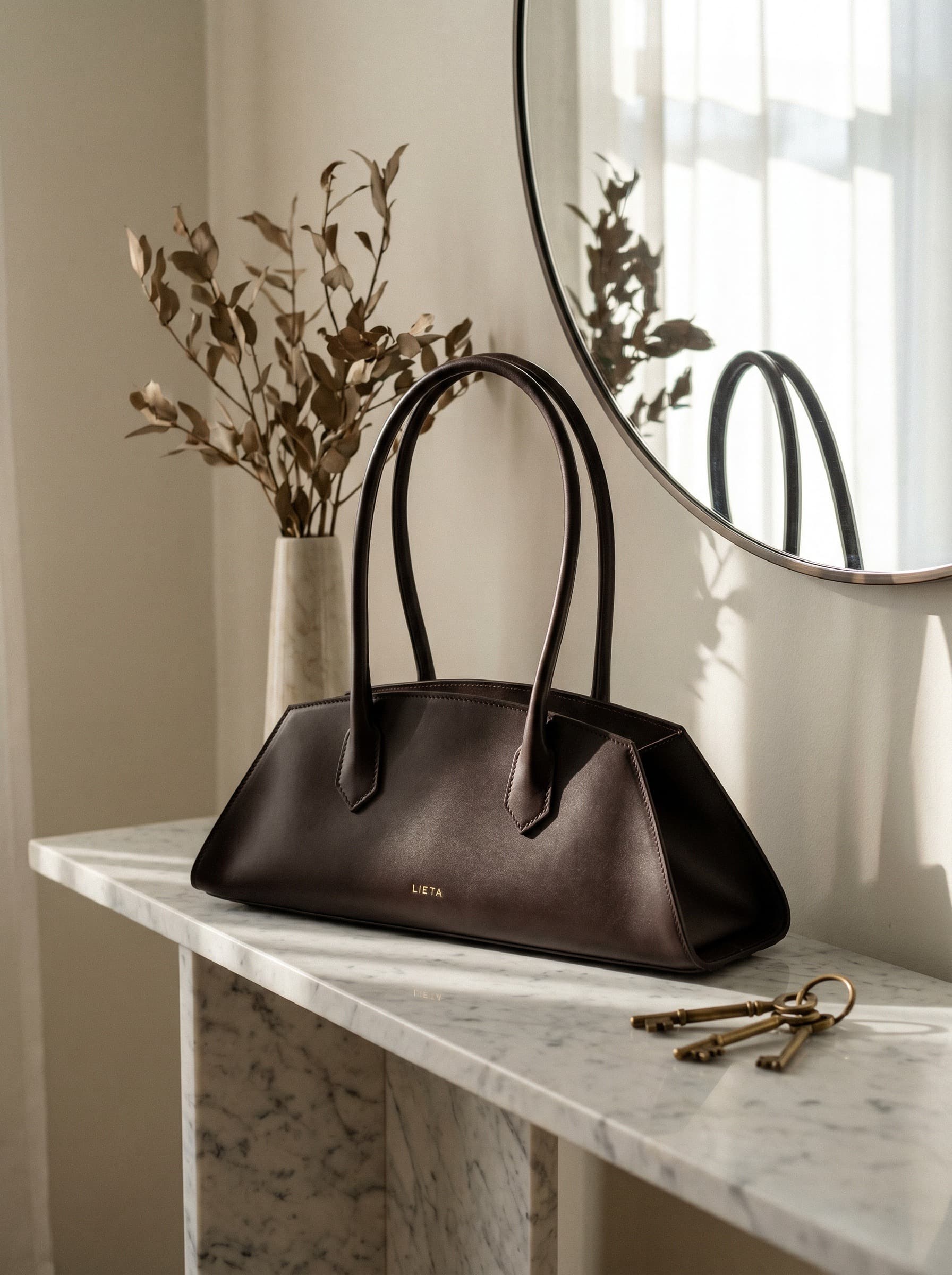
How a leather bag ages: what to expect at 1, 5, and 10 years
Most consumer goods get worse with time. Leather, properly made, is one of the few that gets better. Not in the way marketing copy promises — there is no magical transformation — but in the quiet, specific way a face gets better with the lines that come into it. Here is what to expect, year by year, from a bag in serious full-grain leather.
By The Maison
Year 0: New
A new full-grain Italian calf bag has the most even, predictable look it will ever have. The colour is uniform across all panels. The grain shows its natural pore pattern but with the slight matte sheen of fresh dye. The leather is firm — not stiff, but structured. The edges are crisp and the corners are square.
There is also a smell — the quiet, faintly sweet, slightly woody smell of vegetable-tanned leather. It is most pronounced in the first week and settles after a month.
The hand feel is slightly dry. This is not a problem — it is the leather not yet having absorbed the natural oils from your hand. New leather feels exactly like new leather should feel. The transformation is ahead.
Year 1: First settling
After twelve months of regular carrying, several small things have happened.
The leather has softened. The fibres have relaxed where you most often grip the handles. The bag holds its shape, but the panels move more freely against each other when you open it. It has stopped feeling new.
The colour has deepened slightly. Chocolate is a touch darker. Cream has picked up a faint honey warmth. Black looks the same in most light but slightly richer in raking sun. This is the start of patina — the slow oxidation of plant tannins in light and air.
There may be one or two small surface marks that haven't faded — usually from contact with something sharp (a key, a corner of a credit card). On well-made full-grain, these marks are part of the bag now.
The smell is gone. The leather smells of itself, and of you.
Year 5: The good middle years
This is where leather bags become objects you don't replace.
The patina is now obvious. The colour has continued to deepen — not unevenly, but with subtle variation across panels that have seen more light and oil. Chocolate has gone from a clean tone to a layered one. Cream is now a warm camel. Black has a depth that looks black-on-black under direct light.
The leather has found its hand. It is supple where it needs to be (around the handles, at the front panel against your coat) and structured where it needs to be (at the base, at the corners). This is the hand luxury houses charge a fortune for. You're holding it for free, just from time.
There is a faint sheen on the front panel where the bag has slid against fabric thousands of times. On the handles, the leather has rolled slightly under your hand pressure — a small dent on the upper face of each handle that fits your grip. These are the marks that prove the bag is yours.
Hardware: the gold plating may have softened a fraction at the most-touched points (the zip pull, the brass loops where the handles attach). This is normal and aesthetically positive — gold-plated brass develops a slight warm matte at the points of friction.
Year 10: Mature patina
A ten-year-old full-grain Italian calf bag, used regularly and cared for occasionally, is a different object from the one you bought. Not worse. Different.
The colour has reached its final patina. Chocolate is now a dark, almost burgundy-brown under light. Cream has gone full honey. The variation across panels is significant — the front, which sees the most light, is the most developed; the back is closer to year 5.
The leather is now fully supple. It folds in your hand if you let it. The handle attachments have rolled into a comfortable, soft shape. The corners may have rounded very slightly under repeated pressure — this is the patina speaking.
If you've conditioned it once a year as recommended (a thin coat of neutral leather balm), the leather is still healthy. If you haven't conditioned it at all, it may have a slight surface dryness that one good conditioning will fix in an evening.
Resale value at year 10 for a properly aged Hermès Birkin: roughly 80-100% of original retail. For a properly aged LIETA Lungo: we don't know yet — we're new. But the leather is in the same condition. The brand-equity story is the only difference.
Year 20 and beyond: heirloom status
A leather bag that has been carried for twenty years is no longer a new bag with patina. It is its own object. Vintage Hermès bags from the 1990s are sold for more than new ones, in part because the patina cannot be faked — it is the literal record of a life carried.
At twenty years, with periodic conditioning and a single edge-paint refresh at year ten, a good leather bag is structurally as sound as it was at year 5. The leather is denser, the colour deeper, the marks personal. If the handles have rolled, the brand can re-handle the bag (we offer this; most serious houses do).
This is the implicit pitch of a serious leather bag. Not buy this and it will impress someone for a season. Buy this and it will outlast almost everything else you own.
What can go wrong (and how to fix it)
Dry leather: if you've gone too long without conditioning, the leather can develop a slight chalky look on the front panel. Fix: a thin coat of neutral leather balm (Saphir or similar), rubbed in with a soft cloth, dried overnight. The colour returns.
Water rings: from a single droplet that wasn't dried. Faint pale rings. Fix: lightly dampen the whole panel with a soft cloth, let it air-dry. The rings even out.
Scratches: most surface scratches on full-grain fade on their own as the leather warms and flexes. Rub the scratch with the pad of your thumb — if it doesn't disappear in a minute, a tiny bit of neutral balm and gentle rubbing will get the rest.
Worn handles: at 10+ years the handles can show wear at the most-gripped point. This is fixable — most serious houses (us included) re-handle bags at cost.
Loose stitching: rare on saddle-stitched parts. If it happens on machine-stitched seams, any leather workshop can re-run the seam for a small fee. Don't try to fix it with super glue.
Leathers that age well vs leathers that don't
Ages well: Full-grain vegetable-tanned calf (Walpier Buttero, Tannerie Haas Cuir Russie). Full-grain chrome-tanned calf from a reputable tannery. Saddle leather. Bridle leather. Properly tanned suede with periodic brushing.
Doesn't age well: Coated split leather. Bonded leather. Patent leather (cracks). Most embossed/printed grains (the coating wears unevenly). "Genuine leather" of unknown grade. Heavily dyed surface-coated leather (the coating chips).
The simple test: if you can scratch the surface with a fingernail and reveal a different colour underneath, it's coated and won't age well. If the cross-section of the leather is the same colour all the way through, it's dyed through, and it will.
Frequently asked
- How long should a quality leather bag last?
- A full-grain Italian calf leather bag from a serious workshop should last 20-30 years of regular use without significant degradation, and longer with periodic conditioning. The leather actually improves over the first 5-10 years before reaching its mature patina. Repairs to handles and edges can extend the useful life indefinitely.
- What is patina on leather?
- Patina is the gradual deepening and softening of leather colour and texture that develops with use over years. It comes from slow oxidation of plant tannins in vegetable-tanned leather, absorption of natural skin oils, and minor surface flattening from contact. It is the visible record of carry. Patina is not the same as wear — wear is damage; patina is depth. Only full-grain vegetable-tanned leather develops true patina; coated or bonded leather does not.
- Do all leather bags develop patina?
- No. True patina requires full-grain leather (the natural surface intact, not sanded and printed) and ideally vegetable tanning (which uses plant tannins that oxidise to deepen the colour). Coated split leather, bonded leather and most heavily surface-treated leathers do not develop patina — they either stay the same or degrade. The patina is a distinguishing mark of seriously made leather goods.
- How do I age my leather bag faster?
- You don't. The point of patina is that it's the record of your specific carry — the way your hand grips the handles, the light your bag sees, the places it goes. Artificially aging it (with chemicals, heat, abrasion) damages the leather without producing the depth that real time gives it. Carry the bag, condition it occasionally, and the patina arrives.
- Should I condition my leather bag, and how often?
- Yes, but less than you'd think. A thin coat of a neutral leather balm — Saphir Renovateur is the classic — rubbed in with a soft cloth, once a year, is enough for most calf-leather bags. Over-conditioning saturates the leather and can dull the colour. Suede needs brushing rather than conditioning. If the leather has gone visibly dry, condition; otherwise leave it.
Also from the Journal
What "Made in Italy" actually means (and the loophole most brands use)
There's a difference between a Made in Italy bag and a bag made in Italy. The legal definition is much looser than most people assume. Here's what the label actually guarantees, what it doesn't, and how to ask a brand the right question.
Scandicci: a walking guide to Italy's leather capital
Twenty minutes from the Duomo, on a tramline most tourists never take, sits a town of 50,000 people and 600 leather workshops. Gucci's headquarters is here. Prada produces here. So do we. Here's how to spend a day in the leather capital that built half the bags you've ever wanted.