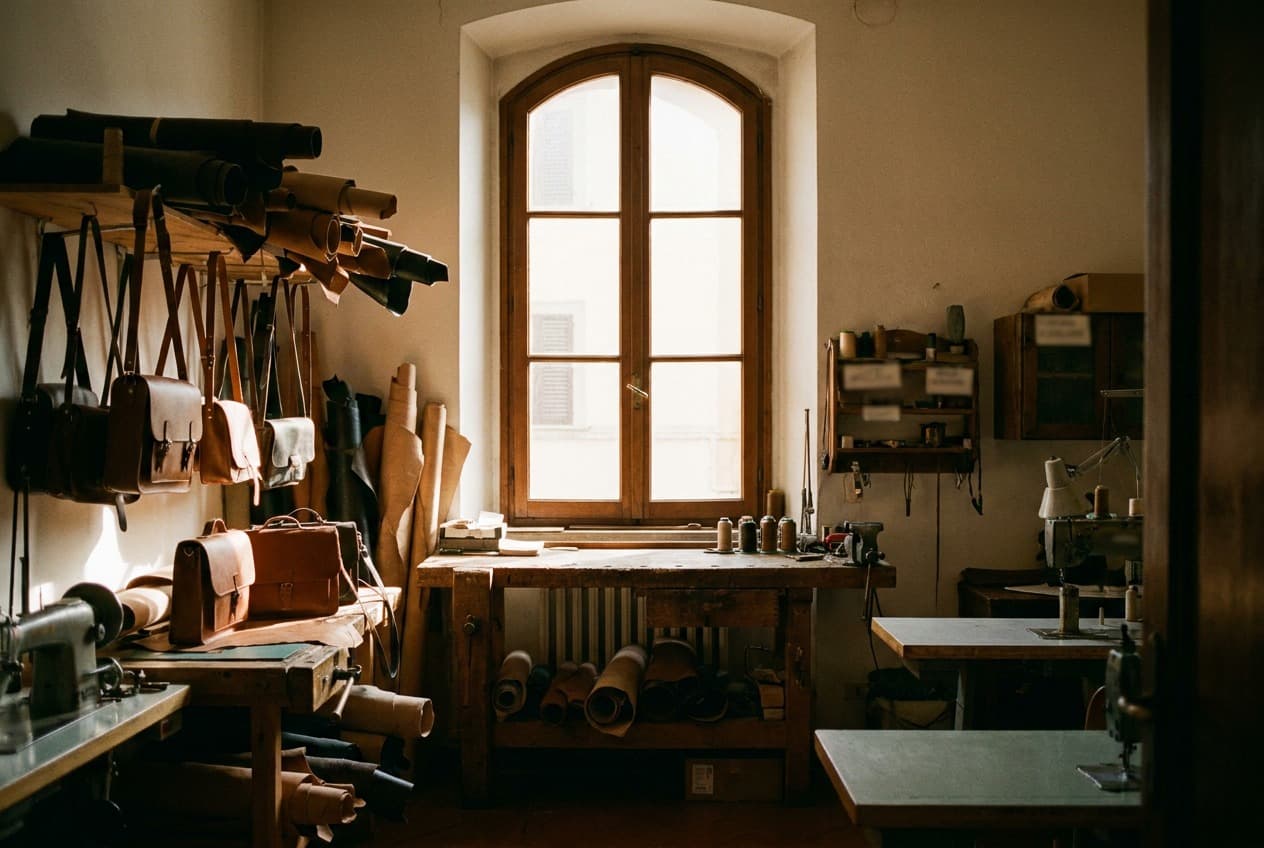
Scandicci: a walking guide to Italy's leather capital
Most people who travel to Florence for the leather never leave the city. They walk through the San Lorenzo market, buy a belt that may or may not be Italian, eat lunch near the Ponte Vecchio, and go home. The actual leather industry — the workshops that supply the famous houses, the tanneries that smell of bark and beeswax, the cutting tables that haven't moved in a hundred years — is twenty minutes west, in Scandicci. If you ever go, here is how to see it properly.
By The Maison
Where Scandicci is and how to get there
Scandicci sits on the western edge of Florence, against the foothills of the Apennines. From central Florence the easiest way there is Tramvia T1 — the green tram that runs from Santa Maria Novella station to Villa Costanza. The journey is about twenty minutes; the fare in 2026 is €1.70. Get off at any of the central Scandicci stops: Resistenza, De Andrè, Centro, or Olmi.
By car, the A1 motorway from Florence west takes about fifteen minutes; from Pisa airport, an hour. Public transport is more pleasant — Scandicci is built around the tramline.
The town does not look like what you've come to see. The centre is a working Italian town: cafés, small piazzas, hardware stores, school kids in tracksuits. The leather industry sits in the industrial zones around the edges. You have to walk for it.
Casellina — the Gucci corridor
Start at Casellina, a kilometre south of the tram. The Gucci global leather-goods headquarters — the Gucci Casellina Hub — opened here in 2018 and now consolidates several of the brand's Tuscan workshops in one campus. It is closed to the public, but you can see the building from the road, and the surrounding industrial estate is essentially a Gucci supplier ecosystem: small workshops that cut, stitch, plate hardware and produce trim for the brand.
The walk from Casellina back toward the centre takes you past San Giusto, where several of the smaller independent ateliers operate. Many of these workshops — unmarked, on side streets, behind metal roller doors — produce for the great French and Italian houses under non-disclosure. You will not be able to identify which workshop produces for which brand. That is by contract.
There is a quiet etiquette here. Stop and look at the buildings from the street, but do not knock or try to enter. The workshops are private working spaces, not destinations.
The Pratolungo workshop district
North of the tram, the Pratolungo industrial zone is where the smaller and newer workshops have set up — including ours. Walk along Via Pratolungo and Via dei Caciaioli and you'll pass dozens of small leather-goods producers. Most have a small sign with a name and a serial number; almost none have customer-facing storefronts.
What you'll smell here is the most interesting thing. Vegetable-tanned leather has a specific scent — slightly sweet, slightly woody — and on a warm afternoon, walking past an open workshop door you'll catch it before you see anything. The smell deepens further at the actual tanneries (which are not in Scandicci itself, but 50 km west — see below).
The workshops break for lunch around 12:30 and reopen around 14:30. If you go between those hours, the streets are quiet and you can hear birds and church bells — and from the open courtyards, occasionally, the sound of a stitching machine running.
Castelfranco di Sotto — the tannery valley
If you have an afternoon, take a regional train from Florence to San Miniato (45 minutes) and then a short taxi or bus ride to Castelfranco di Sotto. This is where the Walpier tannery sits — the source of our Buttero leather and a major supplier to the high end of the Italian leather industry.
Castelfranco is part of the Consorzio Vera Pelle Italiana Conciata al Vegetale — the Italian Vegetable-Tanned Leather Consortium, which protects the centuries-old tanning tradition of the Tuscan leather valley. The towns of Castelfranco di Sotto, San Miniato, Santa Croce sull'Arno and Fucecchio sit along the Arno river and host nearly all of Italy's vegetable-tanning capacity.
Several of the tanneries offer guided visits by appointment — typically arranged through the Consorzio. The tour shows the pit-tanning baths (where hides soak in slowly-strengthening tannin solutions for weeks), the drying lofts, and the finishing benches. It is unlike any other industrial process you'll have seen. The smell is unforgettable.
Where to eat in Scandicci
There are two kinds of lunch places in Scandicci: the cafés where the artisans actually eat, and the slightly more polished trattorie a few blocks inside the centre. We recommend the artisan version.
Trattoria Casalinga della Casa on Via di Casellina is what you want — a working trattoria with €12 set lunches, tablecloths that are checked, and a clientele that is 80% workshop staff in their workwear. Order the peposo if it's on the board.
Caffè del Centro in Piazza Matteotti is the morning espresso stop. The owner has been pouring coffee for the leather district for thirty years. He will know without asking that you are a tourist; he will treat you exactly the same as he treats the artisans.
Skip the obvious tourist places near the tram terminus. They are fine, but they are not Scandicci.
The Outlet Mall — what to know
Twenty minutes south of Scandicci by car is The Mall Luxury Outlet in Leccio, Reggello. This is the famous outlet where Gucci, Prada, Bottega Veneta, Valentino, Givenchy and Yves Saint Laurent operate factory stores at 30-50% off retail. If you came to Florence with outlet shopping on your list, this is the place.
A few honest notes. The discounts are real, but the merchandise is generally previous-season styles, sometimes minor B-grade pieces, and the most desirable bags (Birkins, current-season Pradas) are not here. The Mall is also overwhelmingly Chinese-tour-bus traffic in 2026 — go on a weekday morning if you want it to be tolerable.
The Mall is not a substitute for what Scandicci actually is. The outlet is a sales channel. The town is a production capital.
Why here, since when
The leather trade in Scandicci goes back at least to the 14th century. The Medici family — early Florentine bankers who became dukes — encouraged leather working as part of broader Florentine craft industries that included goldsmithing, silk weaving and bronze casting. The proximity to the Arno river (for water-intensive tanning), the Apennine forests (for chestnut tannins), and the trade networks of Renaissance Florence made the region a natural hub.
The modern industry — with its post-war boom, its consolidation around the great Italian and French luxury houses, and its current 600+ workshops — built on that foundation. The reason Hermès and Prada and Gucci all produce in Tuscany is not coincidence and not marketing. It is the simple density of expertise, equipment, and supply chain that comes from continuous practice over six centuries.
When you carry a bag made here, it is the most recent step in a very old story.
Frequently asked
- Where is Scandicci, Italy?
- Scandicci is a town of about 50,000 people on the western edge of Florence, in Tuscany, central Italy. It sits at the foothills of the Apennines, about 8 kilometres from central Florence, and is connected to the city by the Tramvia T1 (green tram line). The town is the world's densest concentration of luxury leather-goods workshops, with roughly 600 ateliers serving the major Italian and French luxury houses.
- Can tourists visit leather workshops in Scandicci?
- Most workshops in Scandicci are private working spaces and not open to the public. The ones supplying major luxury houses operate under non-disclosure agreements. However, the surrounding Tuscan leather valley — Castelfranco di Sotto, Santa Croce sull'Arno, San Miniato — has several vegetable-tanning tanneries that offer guided tours by appointment, typically arranged through the Consorzio Vera Pelle Italiana.
- What luxury brands are made in Scandicci?
- Gucci has its global leather-goods hub in Scandicci (Casellina). Prada, Celine, Saint Laurent, Loewe, and many smaller maisons produce here either through owned subsidiaries or through independent ateliers. A meaningful share of Hermès production also passes through Italian workshops including some in the Scandicci area, though Hermès is more discreet about which specific workshops it uses.
- How do I get from Florence to Scandicci?
- The easiest way is the Tramvia T1 — the green tram line that runs from Florence Santa Maria Novella station to Villa Costanza in Scandicci. The journey takes about 20 minutes and costs €1.70. Get off at Resistenza, De Andrè, Centro or Olmi for the town centre. By car, the A1 motorway takes about 15 minutes from central Florence.
- Is the Mall outlet near Florence worth visiting?
- The Mall Luxury Outlet in Leccio (about 30 minutes south of Florence by car) offers Gucci, Prada, Bottega Veneta and other luxury labels at 30-50% off retail. The discounts are real but the merchandise is typically previous-season and the most desirable current pieces are not stocked. The Mall is very crowded with tour-bus traffic — visit on a weekday morning for the best experience. It is a sales channel, not where the production happens.
Also from the Journal
What "Made in Italy" actually means (and the loophole most brands use)
There's a difference between a Made in Italy bag and a bag made in Italy. The legal definition is much looser than most people assume. Here's what the label actually guarantees, what it doesn't, and how to ask a brand the right question.
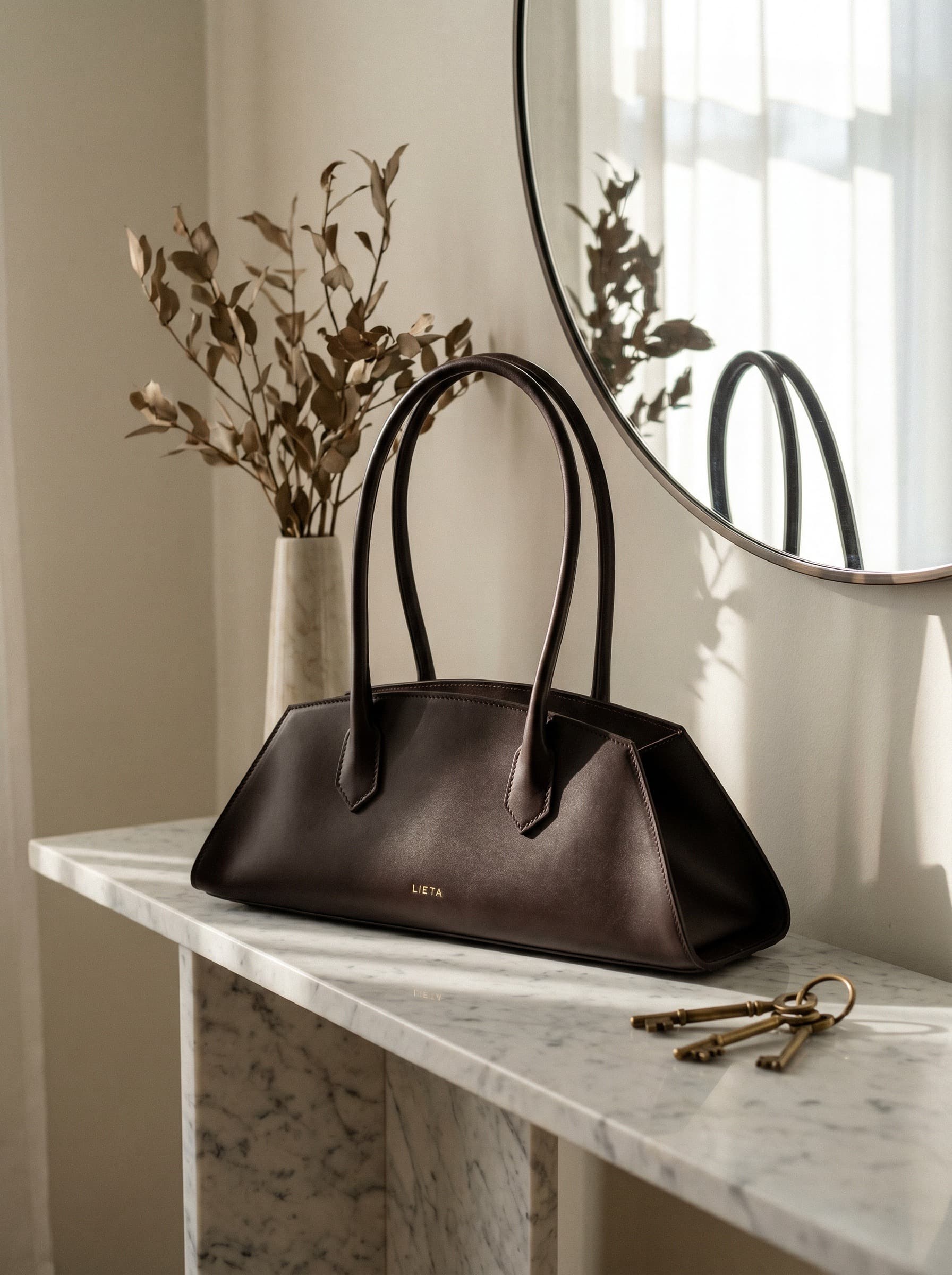
How a leather bag ages: what to expect at 1, 5, and 10 years
Good leather doesn't wear out — it ages. Here's what a proper full-grain Italian calf bag actually looks like at year 1, year 5, year 10 and beyond, with the small things that change and the small things that don't.