How to spot real Italian leather: 7 quick tests anyone can do
There are five quality grades of leather, and four of them are sold using language that is technically true but designed to mislead. The cheapest grade is often labelled "genuine leather" — which makes it sound like the best of the four, when in fact it is the worst. Here is how to actually tell the difference, in the time it takes to hold a bag in a shop.
By The Maison
1. The smell test
Pick up the bag and put your nose to it. Real vegetable-tanned full-grain leather has a faint, sweet, slightly woody smell — closer to a saddle or an old library than to a chemistry set.
Chrome-tanned leather (still real leather, but lower-end) has a sharper, slightly chemical scent — the chromium salts that did the tanning.
"Genuine leather" and bonded leather usually smell of plastic, glue, or nothing at all. If it smells like a new car interior or a vinyl raincoat, it isn't really leather.
2. The water-droplet test
(Only do this if it's your bag, or with the seller's permission.)
Drop a single droplet of water on an inconspicuous spot — the bottom corner is good.
Full-grain vegetable-tanned leather absorbs the water slowly and darkens slightly where the drop sat. The dark spot fades over the next hour as the water evaporates. This is normal and good.
Chrome-tanned leather tends to repel the water — the droplet beads on the surface.
Coated split or bonded leather often shows the water sitting on a plastic-feeling surface, with no absorption at all. The coating is preventing the leather underneath from interacting with water.
3. The edge test
Look at the cut edge of the leather — where two panels meet, or where the strap ends.
Full-grain leather has a cut edge that shows the natural cross-section of the hide — slightly fibrous, with the same colour all the way through (if the leather is dyed through) or a natural beige core (if surface-dyed).
Top-grain or coated leather often shows a sharp two-layer edge — a thin coloured coating on top, lighter material underneath. The coating can sometimes peel slightly at the edge.
Bonded leather shows a completely uniform, almost rubbery cross-section — because it's literally leather dust pressed into a sheet with binder.
On any quality bag, the edge will also be painted in 3-4 coats of colour-matched dye. The painted edge is itself a sign of seriousness — cheap bags don't get this finish.
4. The grain test
Look at the surface in good light — natural light is best.
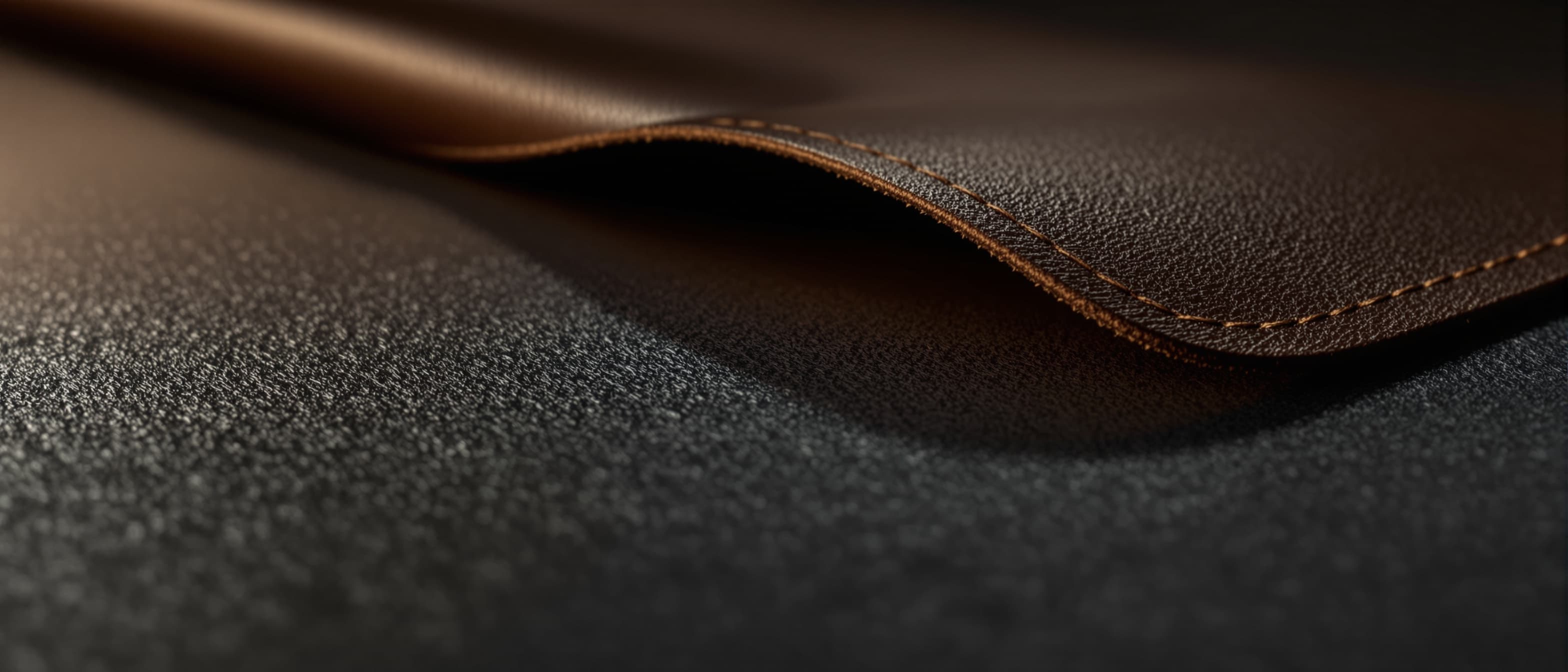
Full-grain leather has an irregular grain pattern. Pores vary in size and spacing. There are subtle marks from the animal's life — a faint scar, a slight pucker, a vein line. These are not defects. They are the proof that the surface hasn't been sanded.
Top-grain leather has a perfectly uniform grain — because it was sanded away and a new grain stamped on. The pores will be evenly spaced and identical in size.
Embossed or printed leather often has a repeating pattern. If you can see the same exact "natural" feature appearing twice on the same piece, it's stamped.
5. The weight test
Pick up the empty bag.
Full-grain Italian calf is dense. A medium handbag in this leather typically weighs 500-800 grams empty.
A bag in cheap split leather of the same dimensions weighs significantly less — often 250-400 grams. The leather is thinner because the lower layers of the hide are weaker and stretch more easily, so they have to be split thin to be usable.
There is such a thing as a bag that's too heavy — solid metal hardware and structured bases can push the weight up — but in general, lightness is suspicious in handbags claiming to be in serious leather.
6. The price test
Raw full-grain Italian calf wholesales at €55-€110 per square metre. A medium handbag uses 1.5-2.5 square metres. That's €82-€275 of leather alone before any labour, hardware, or margin.
If the entire finished retail price of the bag is €100-€150, the leather is not full-grain. There is no way to make those numbers work without using a much cheaper material — usually a corrected-grain (sanded top), split leather (the bottom layer), or coated bonded leather.
Anyone selling "genuine leather" bags at €80 is selling you something that is technically leather and substantively plastic. The maths makes it impossible otherwise.
7. The label test
Read the label carefully. Quality grades have specific names, in this order:
Full-grain leather — the entire top layer of the hide, untouched. The highest grade.
Top-grain leather — top layer with the surface sanded smooth and a new grain printed. Common in mid-market bags.
Split leather / corrected-grain — the lower layers of the hide. Weaker, but real leather.
Genuine leather — a deliberately misleading legal term that means "contains some leather" and typically refers to the lowest grade — split leather with a heavy plastic coating.
Bonded leather — leather dust glued into a sheet. Not really leather in any meaningful sense.
"Vera Pelle" on Italian leather goods means "real leather" — same legal status as the English "genuine leather." Doesn't tell you the grade. "Pieno Fiore" means full-grain.
Frequently asked
- How can I tell if a leather bag is real?
- Use multiple tests together — no single test is definitive. Smell (real leather is faintly sweet, not chemical), weight (full-grain calf is dense — 500-800g for a medium bag), edge (the cross-section should show fibrous leather all the way through, not a plastic coating on a different substrate), and grain (a real grain has irregular pore spacing and natural marks; printed grains repeat). Cross-check with price — a full-grain bag cannot retail under about €200 in any honest market.
- What does "genuine leather" actually mean?
- "Genuine leather" is a legal term that means "contains leather" — but it almost always refers to the lowest-quality grade: split leather (the bottom layers of a hide) with a heavy plastic-like coating printed to look like grain. It is the opposite of what the word "genuine" implies. Higher grades are called "full-grain" and "top-grain" — those are the labels you want to see.
- Does real leather smell?
- Yes. Vegetable-tanned full-grain leather has a quiet, slightly sweet, faintly woody smell that deepens over the first year. Chrome-tanned leather has a sharper, slightly chemical scent. Coated split or bonded leather often smells of plastic or has no smell at all. The smell is one of the most reliable quick tests.
- Why is "genuine leather" so cheap?
- Because it's the lowest-grade leather product available. It's typically made from the split layers of a hide (the leather left over after the prized top grain has been removed for higher-grade products), coated with a thick plastic surface that mimics natural grain. The plastic coating cracks within a few years of regular use, exposing the fragile underlying material.
- How do you tell if leather is full-grain?
- Three signals together: an irregular grain pattern with varied pore sizes (printed grain repeats uniformly); a cut edge that shows fibrous leather across the cross-section rather than a thin coating on top of something else; and natural marks — a faint scar, a slight pucker, a vein line — that prove the surface hasn't been sanded down. Full-grain leather also feels denser in the hand and develops a patina with use rather than cracking.
Also from the Journal
Where Hermès bags are actually made (and why ours come from the same district)
Ask where your Hermès Birkin is made and the honest answer surprises most people. It's not Paris. The leather, the cutters, much of the work — they all travel through the same Italian leather district we work with. Here's a tour.
Why does a luxury handbag cost €4,000? The real markup breakdown
A €4,000 handbag isn't €4,000 of materials. The leather costs what the leather costs. The stitching takes the hours it takes. So what makes up the rest of the price tag? We did the maths.