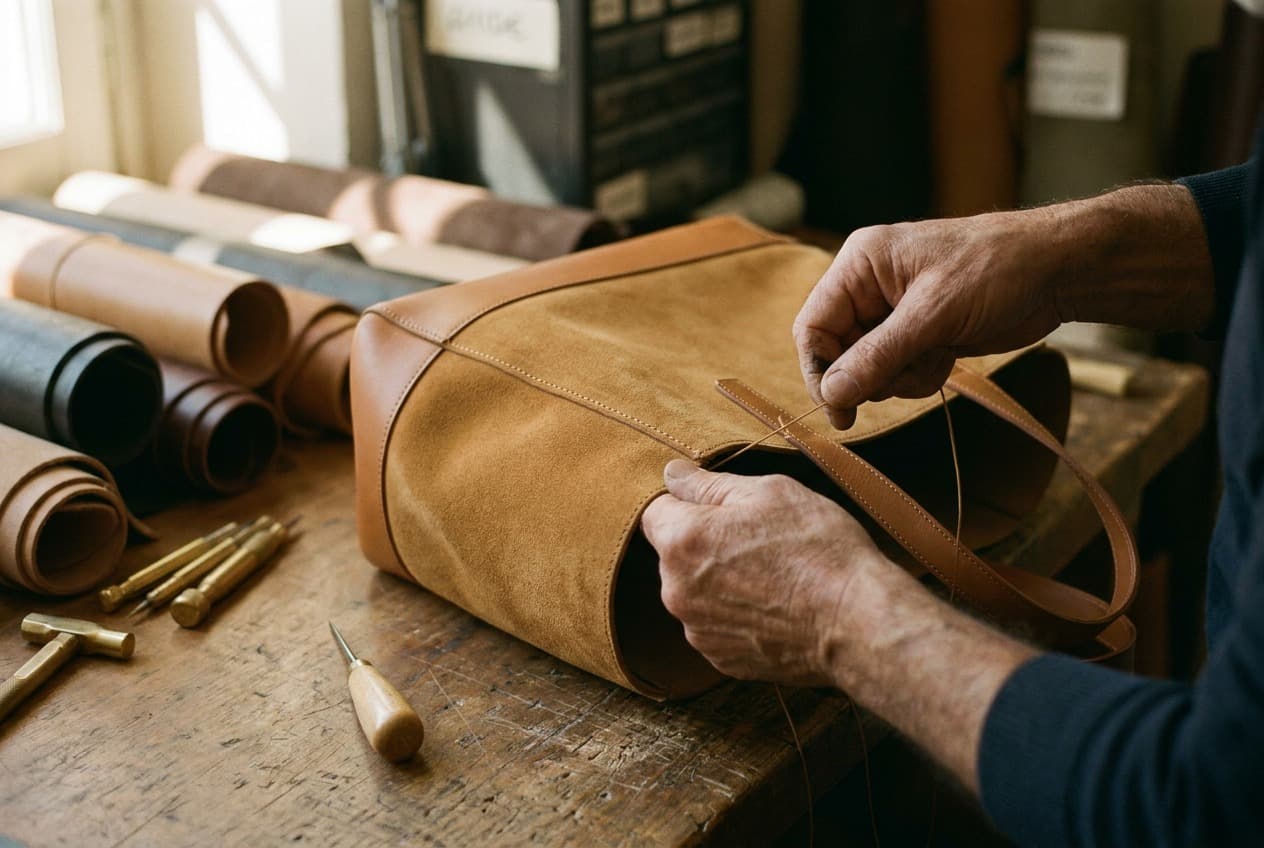
What is saddle stitch? The 250-year-old technique we still use
Almost every handbag on earth is sewn by machine. Industrial sewing machines are precise, fast, and produce a stronger seam at the body of a bag than any human can. But there is one place where machines lose to hands: the points of greatest stress — the handle attachments, the strap loops, the structural tabs. Those parts get saddle-stitched, a technique that has barely changed since 1780 because nothing better has been invented.
By The Maison
What saddle stitch actually is
Saddle stitch is a hand-sewing technique that uses two needles working one continuous thread in opposite directions through the same hole.
Each hole is pre-pierced through both pieces of leather with a pricking iron — a multi-pronged steel tool that punches a line of holes at a consistent angle and spacing. The leatherworker then sits with the two pieces clamped vertically in a stitching pony (a wooden vice that holds the work) and pulls the two needles through each hole, one going left, one going right, threading them past each other.
Each hole therefore receives two passes of thread, crossing inside the leather. From the outside, both faces of the seam look identical — a clean diagonal line of stitches. From the cross-section inside the hole, the threads X past each other.
Why it lasts longer than machine stitch
Machine stitching uses two threads — a top thread and a bobbin thread underneath — interlocked at each stitch. If one thread breaks at any point along the seam, the whole row can progressively unravel because the bobbin loops have lost their lock. This is why a coat sleeve that catches on a doorknob can split open a full inch of seam in one tug.
Saddle stitch can't unravel that way. Each hole has two independent thread passes, and the two ends of the thread are tied off and waxed at the start and end of the seam. If one stitch in the middle of the seam breaks, the threads on either side of the broken hole are still individually locked into their own holes. The seam stays closed until another stitch fails — and so on.
A saddle-stitched seam has to fail one stitch at a time. A machine-stitched seam can fail in a single run.
The thread: waxed linen, not nylon
Serious saddle stitching is done with waxed linen thread — natural flax fibres twisted together and coated in beeswax. The wax serves two purposes: it makes the thread easier to feed through tight holes, and it tightens the stitch against itself once the wax cools inside the leather, effectively gluing each stitch in place.
Cheap saddle-stitch imitations use synthetic nylon thread, which is stronger in tensile testing but lacks the friction-lock behaviour of waxed linen. A nylon thread can slip loose inside the hole; a waxed linen thread sets there.
We use the same supplier of waxed linen thread as the famous houses — a small French and Italian manufacturer whose business model is essentially "saddleries and people who care about saddleries."
When we use it
On every LIETA bag, saddle stitch is used at:
The handle attachments. The two points where the handle loops meet the body of the bag take more stress than anywhere else — every time the bag is lifted, the full weight loads onto those four square centimetres of leather. Saddle-stitched, with a reinforcement tab underneath.
The inner tab. The small leather tab inside the bag that anchors the lining to the leather body. Saddle-stitched so the lining stays seated through years of opening and closing.
The serial card holder. Inside the bag, a small saddle-stitched leather pocket holds the authenticity card.
Everywhere else — the side seams, the bottom, the long structural seams — is machine-stitched at eight stitches per inch with a Pfaff industrial machine. We are not using machine stitch because it's cheaper (it is roughly the same cost when you account for skilled-machine-operator time); we use it because it's stronger and more consistent for long straight seams.
How to spot real hand saddle stitch
Look at the underside of any stitched edge on the bag.
Real saddle stitch: the stitches look identical on both faces. You see two threads crossing each other inside each hole — the slight X visible if the leather is thin enough to see through.
Machine stitch: one face shows a clean diagonal line of stitches; the other face shows little loops where the bobbin thread interlocks. Both faces are not identical.
Fake saddle stitch: some brands run a machine stitch with a special needle that imitates the look of saddle stitch on the top face — but on the back, you'll still see the bobbin loops. If both faces are identical AND there is no bobbin pattern, it's real saddle stitch.
It is rare to find real hand saddle stitch on bags under €1000 at the famous houses. It is on every LIETA, on the parts that need it. That's deliberate.
How long it takes
A skilled saddle-stitcher can do about 4-6 stitches per minute on prepared (pre-pricked) leather, including pulling each thread tight. A typical LIETA handle attachment has around 30 stitches per side. Both sides of a single handle therefore take about 12-15 minutes of focused work, including thread setup and finishing.
Add the two handles, the inner tab and the serial pocket, and there is roughly 45 minutes of hand saddle stitch per Lungo. Multiply by skilled-labour rates (€18-22/hour in Scandicci) and you get €15-€18 of just-the-saddle-stitch labour cost per bag.
It is not a huge number on the bill of materials. It is a meaningful number when you multiply across a year of production, which is part of why most mass-market "luxury" brands have quietly moved this work to a machine. We haven't, because the failure mode of machine stitch in those locations is a customer-service problem, not just a craft preference.
Why we still do it
A 30-year-old hand-saddle-stitched belt that has been worn every day still has its stitches intact. A 5-year-old machine-stitched belt at a similar price point usually has at least one rebuild of the buckle attachment behind it.
We are selling bags that we want to be heirloom objects. Heirlooms can't fail at the load-bearing points. Saddle stitch is what makes that promise honest.
Frequently asked
- What is saddle stitching?
- Saddle stitching is a hand-sewing technique that uses two needles working one continuous thread in opposite directions through the same pre-pierced hole. Each hole receives two thread passes that cross inside the leather. It produces an identical stitch pattern on both faces of the seam and — uniquely among leather-sewing techniques — cannot unravel from a single broken stitch.
- Is saddle stitch better than machine stitching?
- For load-bearing seams on leather goods, yes. Machine stitching uses interlocking bobbin loops that can progressively unravel if one thread breaks; saddle stitch's two independent thread passes mean each stitch is locked into its own hole, and the seam has to fail one stitch at a time. For long straight seams at the body of a bag, modern industrial machines are stronger, more consistent, and faster — which is why most leather workshops use both techniques in different places.
- How is hand-saddle-stitched leather different?
- Visually, both faces of a saddle-stitched seam look identical — a clean diagonal line of stitches on top and bottom. Machine stitching produces a clean line on one face and small bobbin loops on the other. Structurally, saddle stitch has roughly 2-3x the time-to-failure of machine stitch under repeated stress loading, which is why it is used on handles, structural tabs and other high-stress attachment points.
- How long does it take to saddle-stitch a handbag?
- Hand saddle stitching at the load-bearing points of a typical handbag — handle attachments, inner tabs, serial pocket — takes roughly 45 minutes of skilled focused work. The body seams of a bag are typically machine-stitched at eight stitches per inch, which is faster and produces a stronger straight seam than hand work.
Also from the Journal
Where Hermès bags are actually made (and why ours come from the same district)
Ask where your Hermès Birkin is made and the honest answer surprises most people. It's not Paris. The leather, the cutters, much of the work — they all travel through the same Italian leather district we work with. Here's a tour.
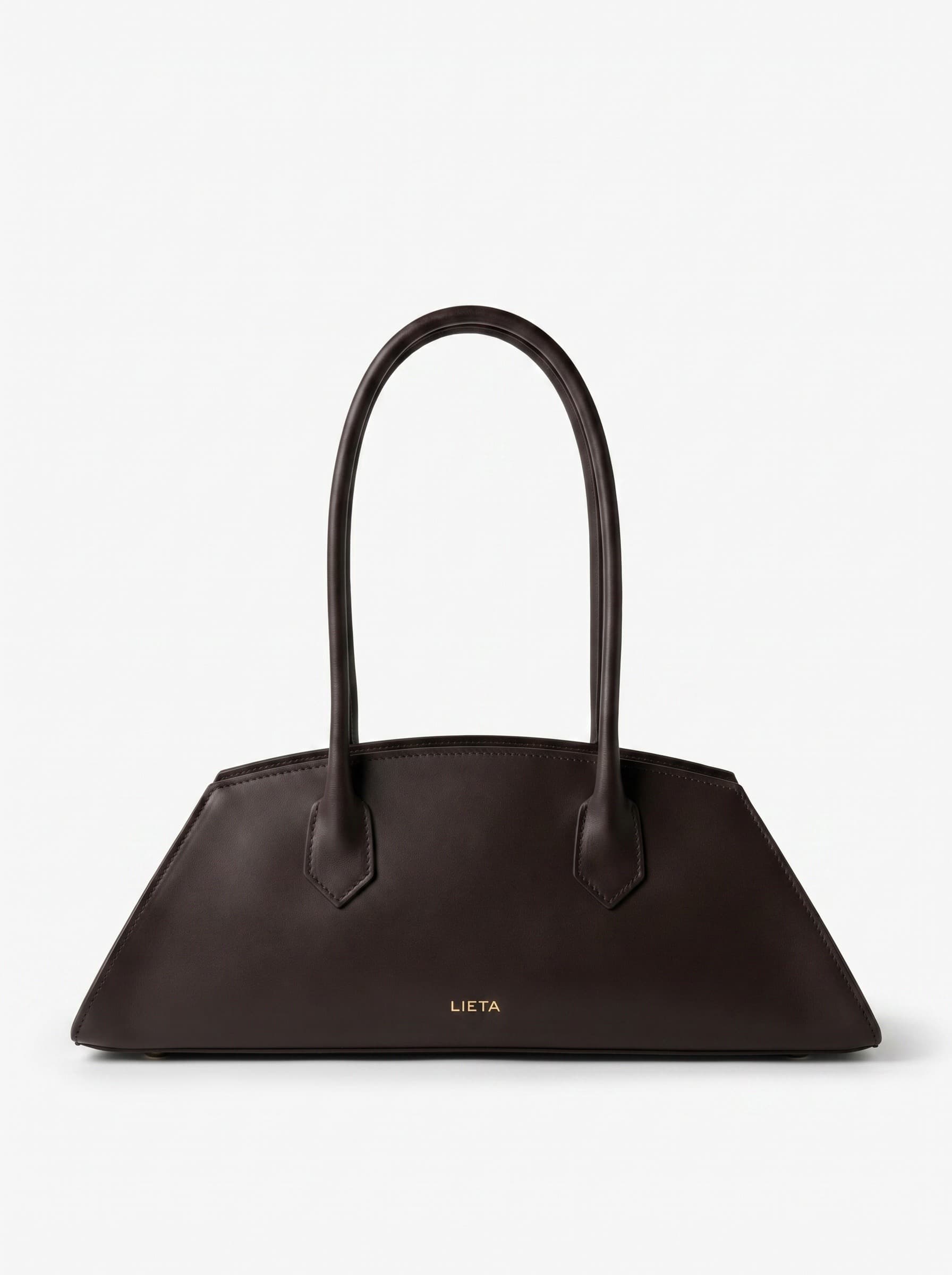
Why does a luxury handbag cost €4,000? The real markup breakdown
A €4,000 handbag isn't €4,000 of materials. The leather costs what the leather costs. The stitching takes the hours it takes. So what makes up the rest of the price tag? We did the maths.